Look, I know exactly how you’re feeling right now. You’re staring at a pre-clinic bench, gripping a wax block, and hyperventilating because the instructor just told you to carve tooth #14.
Is it the Universal #14 (upper left first molar)? Or is it the FDI #14 (upper right first premolar)? Mix those two up, and you’ve just spent three hours carving the wrong anatomy for a zero.
Memorizing dental numbering systems is one of the most frustrating early hurdles in dental school. But it doesn’t have to be a nightmare. Let’s break down these three systems so you never carve the wrong tooth again.
The Universal Numbering System
This is the system primarily used in the United States. It is simple, linear, and assigns a unique number or letter to every single tooth.
Numbered sequentially from 1 to 32.
The Path: You start at the upper right third molar (#1),
go across to the upper left third molar (#16),
drop down to the lower left third molar (#17),
and finish at the lower right third molar (#32).

The FDI World Dental Federation System
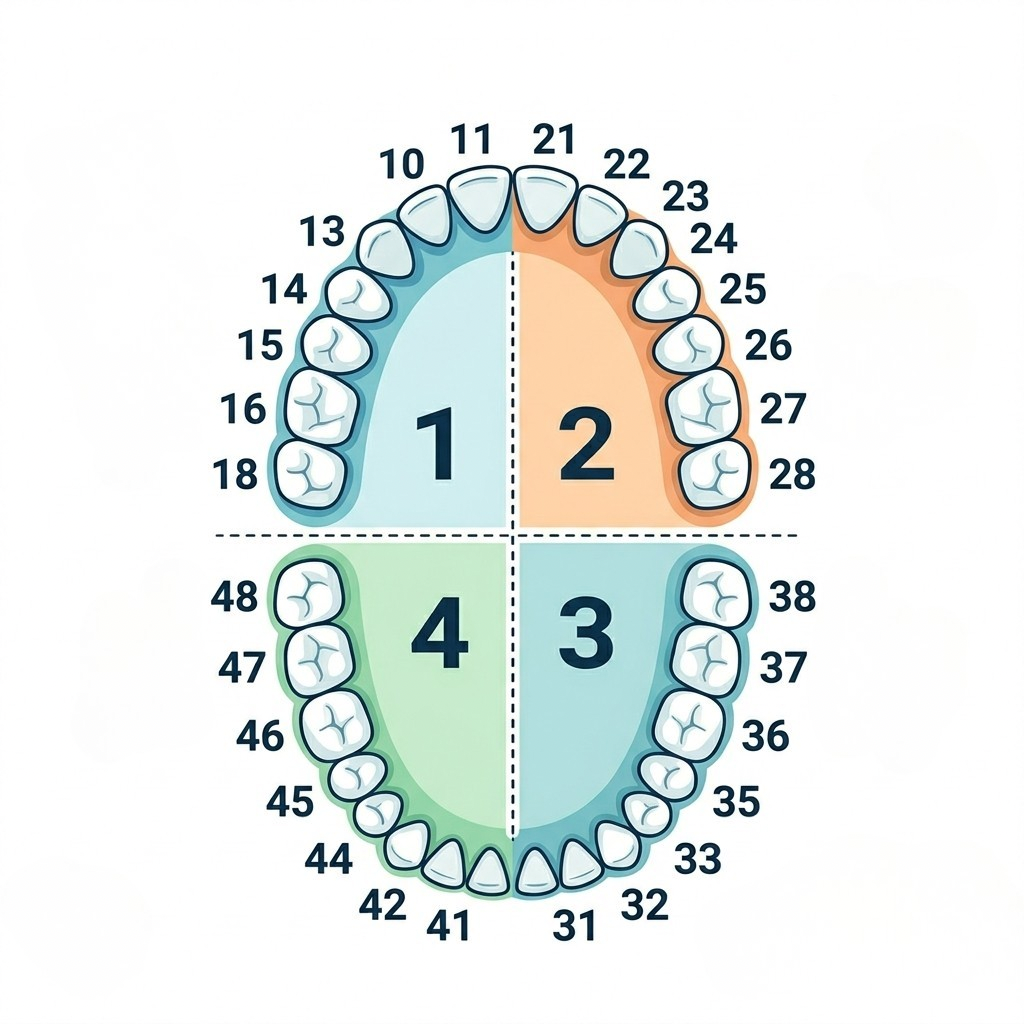
If you practice internationally or read global dental research, FDI is your go-to system. It relies on a brilliant two-digit grid that prevents any left/right confusion.
The first digit represents the quadrant, and the second digit represents the tooth position radiating outward from the midline.
Example: Tooth 47 is the lower right second molar (Quadrant 4, Tooth 7).
The Palmer Notation Method
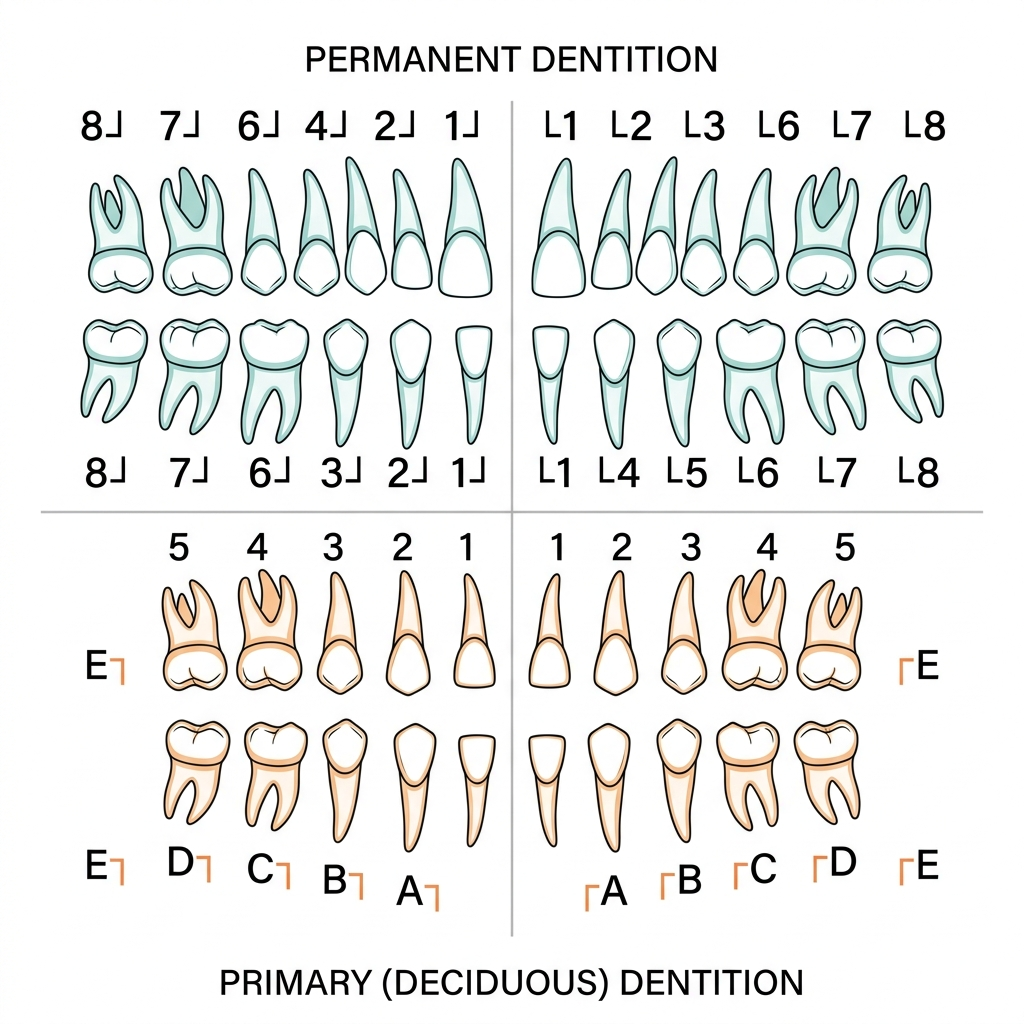
You will mostly see the Palmer system in orthodontics and oral surgery. Instead of relying purely on numbers to dictate location, it uses symbols to visually represent the quadrants.
The Grid: An L-shaped bracket shows exactly which quadrant the tooth is in.
The Numbers: Just like FDI, teeth are numbered 1 through 8 from the midline backward.
Primary Teeth: Letters A through E are used inside the brackets instead of numbers.